Your Reviews Now Determine If AI Recommends Your Business

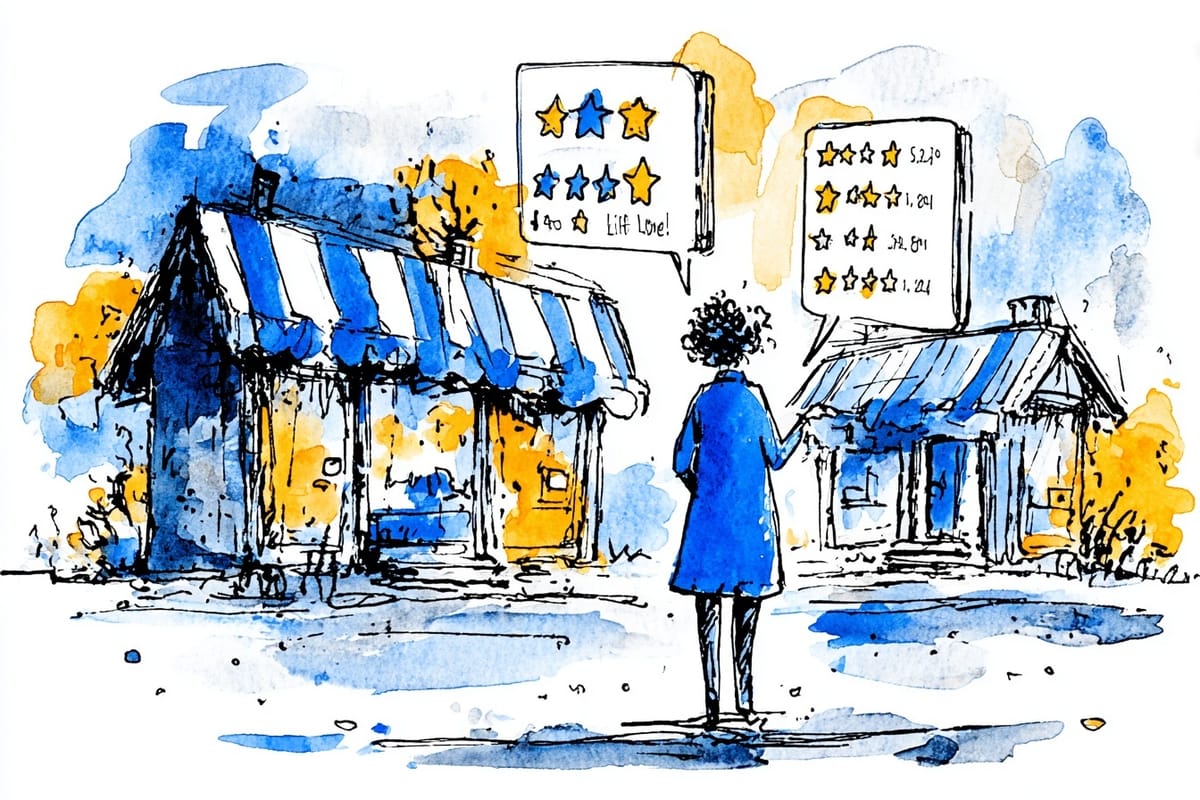
For years, the review game was simple: more five-star reviews meant better visibility on Google Maps, higher click-through rates, and stronger social proof on your website. Reviews were a trust signal. Now they're something more significant — they're a ranking input for a new generation of AI systems that are increasingly becoming the first stop for consumers deciding where to spend their money.
If your business isn't showing up when someone asks ChatGPT, Gemini, or Perplexity for a recommendation, your review profile is likely a major reason why.
AI Has Quietly Become a Referral Engine
The numbers tell the story quickly. AI-referred sessions grew 527% year-over-year in the first five months of 2025. Google AI Overviews are now appearing in more than 16% of all searches. And according to MarketingCode, the share of consumers using AI search for local services has jumped from 6% to 45% in just the past two years.
This isn't a channel that's coming — it's a channel that's here. And the businesses getting recommended aren't necessarily the ones with the best SEO or the biggest ad budgets. They're the ones with the strongest, most credible review profiles.
How AI Actually Evaluates Your Business
When an AI system surfaces a business recommendation, it isn't crawling your website copy or reading your About page. It's evaluating trust signals — and reviews are the densest concentration of trust signals available.
Here's what AI systems appear to be weighting most heavily:
Review volume with recency. A business sitting on 12 Google reviews from 2019 is functionally invisible to AI recommendations. Early testing with Google's AI Mode shows that businesses with 100+ reviews and recent activity consistently surface over those with thin or stale review profiles. AI treats recency as a proxy for whether you're still actively serving customers well.
Star rating thresholds. Businesses with ratings below 4.5 are generally filtered out of AI-generated recommendation lists. Early data from Search Engine Journal and other researchers suggest that AI-generated answers for queries like "best [service] near me" overwhelmingly favor businesses at 4.7 stars or higher. This isn't Google's traditional ranking algorithm — it's a confidence threshold. AI isn't linking to options; it's making a confident recommendation.
Review sentiment and specificity. Generic five-star reviews ("Great service!") carry less weight than reviews that describe specific experiences, outcomes, or staff members. AI models analyze patterns across your review corpus. A business with 80 reviews that consistently mention "fast turnaround," "knowledgeable staff," or "fixed our issue the first time" gives AI something concrete to synthesize into a recommendation. Businesses with thin or vague review content, even at high volume, come across as less authoritative.
Review response behavior. Whether and how you respond to reviews is increasingly being read as a signal of business activity and professionalism. Businesses that regularly engage with reviewers — particularly on negative reviews — appear more trustworthy to AI systems than those that leave reviews unacknowledged.
This Is What GEO Looks Like in Practice
Generative Engine Optimization (GEO) — the discipline of positioning your brand to be cited and recommended by AI platforms — has emerged as one of the most discussed topics in search marketing. Unlike traditional SEO, which is dominated by technical signals and link graphs, GEO depends heavily on authentic reputation signals. Research from Brandlight found that the overlap between top Google organic results and AI-cited sources has dropped from 70% to below 20%. The sources AI trusts are increasingly different from the sources Google's traditional algorithm ranks.
What does that mean practically? A business that has invested in review acquisition, review quality, and review responsiveness has quietly been building the foundation of a GEO strategy — even if they didn't know that's what it was called.
What to Do About It
If you're responsible for a client's or your own business's digital presence, the review profile you build today is the AI visibility you earn tomorrow. A few areas to focus on:
Prioritize volume and recency simultaneously. Don't treat review collection as a one-time push. Ongoing review acquisition — automating requests after purchases, service appointments, or project completions — keeps your profile fresh and signals to AI systems that the business is consistently active.
Go where AI is listening. Google reviews remain the primary input for most local AI recommendations, but Yelp, Trustpilot, G2, and Capterra are also indexed and referenced, particularly in vertical-specific searches. Your review strategy should reflect where your customers are and where AI is likely to pull from.
Coach for specificity. Review request templates that prompt customers to mention specific outcomes ("What problem did we solve for you?") or specific attributes ("What made us stand out compared to others you considered?") generate more substantive content that AI can work with.
Respond consistently. AI systems reward engagement signals. Responding to every review — positive and negative — within a reasonable window is good customer service and increasingly good GEO hygiene.
The Reviews You're Not Getting Are Costing You More Than You Think
The cost of not having a robust review profile used to be measured in missed clicks and lower map pack rankings. The cost now includes invisibility to an entirely new discovery channel that 45% of consumers are already using to find local services — and growing.
If your review acquisition process is still manual, inconsistent, or dependent on customers taking action unprompted, you're ceding ground in a channel that compounds over time. Platforms like More Good Reviews automate the entire review collection workflow — sending personalized email and SMS requests, routing customers to your highest-priority review platforms, and keeping your profile current — so you're building AI visibility as a byproduct of just running your business well.
The businesses AI recommends are the businesses customers trust. And increasingly, those two things are the same list.