Review Velocity: The Ranking Signal You're Probably Ignoring
Review velocity, the pace at which new reviews arrive, is now a measurable ranking signal for both local SEO and AI search engines. Here's the data behind it and how local businesses can build it sustainably.

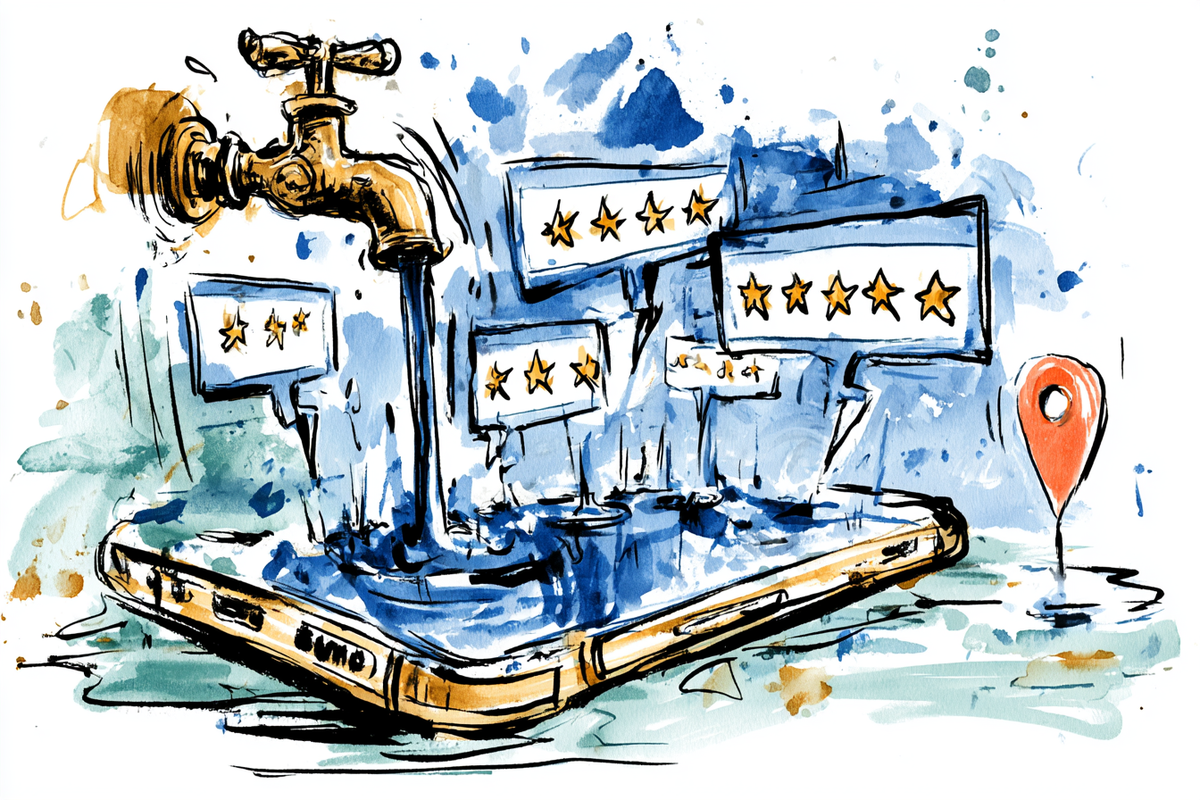
If you've been keeping your review count steady but your rankings still feel stuck, the number of reviews you have might not be the problem. It could be the pace at which they're arriving.
Review velocity is the rate at which a business collects new reviews over time, usually measured weekly or monthly. It's different from total review count, and it's increasingly one of the clearest signals both Google's local algorithm and AI answer engines use to decide whether a business is active, trusted, and worth recommending right now.
Here's what the data actually shows, and how to build sustainable velocity for your own business.
What review velocity actually measures
Total review count answers "has this business earned trust over time." Review velocity answers a different question: "is this business still earning trust today."
A business with 400 reviews collected steadily over five years reads very differently to a search algorithm than a business with 400 reviews where 350 arrived in the last three months. The second pattern looks less like organic customer satisfaction and more like a coordinated push, which is exactly the kind of behavior Google's spam systems are built to catch.
The local SEO case: review signals are carrying more weight
Whitespark's 2026 Local Search Ranking Factors report, based on survey data from local SEO practitioners, ranks several review metrics among the most impactful factors for local pack and Google Maps visibility:
- Quantity of native Google reviews with text: ranked 9th overall
- Review recency: ranked 11th overall
- Sustained influx of reviews over time, rather than bursts: ranked 14th overall
That third factor is the one worth sitting with. Whitespark's own framing draws a direct line between steady, ongoing review acquisition and ranking performance, explicitly favoring consistency over spikes. The report also notes that review signals carry meaningfully more weight in 2026 than in prior years, which tracks with how much local search has shifted toward proof-of-activity signals as Google works to filter out fake and incentivized reviews.
The GEO case: AI engines are reading the same signals
Generative Engine Optimization, or GEO, is the practice of getting your business surfaced and recommended inside AI-generated answers from tools like ChatGPT, Google's AI Overviews, Perplexity, and Gemini. Unlike a ranked list of ten blue links, these tools synthesize a single recommendation, so what they choose to trust matters even more.
According to Search Engine Journal's reporting on the local signals AI now reads, volume, recency, sentiment, and response rate all function as trust signals for AI systems, not just star rating. The piece notes that businesses recommended by these tools currently cluster around certain average ratings (roughly 4.3 stars for ChatGPT, 4.1 for Perplexity, and 3.9 for Gemini), but a lower rating doesn't disqualify a business if the underlying signals, including how recently and how consistently reviews are coming in, look healthy.
The practical takeaway: AI engines are pulling from the same review data Google's local algorithm uses, and recency is doing a lot of work in both systems. A profile that hasn't collected a new review in four months reads as stale to an algorithm and to a language model summarizing "the best option near me" alike.
Why chasing velocity the wrong way backfires
It's tempting to read "sustained influx matters" and respond by buying a batch of reviews or running an aggressive one-time review push. The data says this is exactly the wrong move.
A large-scale study by Localo analyzed over 335,000 deleted Google reviews across more than 22,000 business profiles and found a stark relationship between velocity and review survival: profiles receiving 100 or more reviews in a single week had those reviews removed within a median of 6 days, compared to a median lifespan of 594 days for profiles adding just 1 to 2 reviews per week. That's a roughly 99x difference in how long the reviews actually stick around.
The study also found that detection has gotten much faster industry-wide. Generic five-star reviews posted in 2017 lasted a median of nearly 2,900 days before removal; by January 2026, that median had dropped to just 5 days. High-velocity profiles also showed telltale patterns Google's systems flag automatically, including review clusters that were nearly 98% five-star and heavy use of generic phrasing like "highly recommend."
Localo's research points to 2 to 5 organic reviews per week as a sustainable range for most local businesses. Below that, you risk looking stale. Well above it in short bursts, and you risk a deletion event that erases the very progress you were trying to make.
How to build review velocity the right way
The goal isn't more reviews all at once. It's a steady, repeatable process that keeps new reviews coming in every week without looking manufactured.
Ask at the moment of peak satisfaction. The highest response rates come from requests sent right after a service is completed or a purchase is picked up, not days later. Build the ask into your existing workflow (a checkout step, a follow-up call, a job completion form) instead of treating it as a separate task someone has to remember to do.
Automate the request, not the review. Use SMS and email review requests triggered automatically from your point of sale, CRM, or scheduling system. Automation keeps the cadence consistent even when your team is busy, which is what produces the steady drip pattern Google and AI engines reward. Just make sure the review itself is written by the actual customer; automating the ask is fine, automating or incentivizing the content is not.
Spread requests across your customer base, not just your happiest week. If you only ask for reviews after a big promotion or a slow news week when your team has time, you create the exact burst pattern that gets flagged. Tie review requests to every completed transaction so the flow stays even month to month.
Make responding part of the process. Response rate is its own signal in both the Whitespark data and the AI search research above. Set a standing habit of replying to every new review, positive or negative, within a few days. This also naturally reinforces recency since your profile shows fresh activity even between new reviews.
Diversify where reviews land. Google is the priority for local pack visibility, but a presence on the platforms your customers already use (Facebook, industry-specific sites, Yelp where relevant) rounds out the signal set AI tools pull from when building a picture of your business.
Monitor velocity, not just volume. Track new reviews per week or month, not just your running total. If you notice a gap of several weeks with nothing new, that's the moment to nudge your request process, not wait for a slow quarter to try to make it up all at once.
Never buy reviews or run incentivized campaigns. Beyond the ethical and platform-policy issues, the Localo data makes the practical risk explicit: the reviews you buy in bulk are now, on average, the reviews Google removes fastest.
The bottom line
Review velocity has moved from a nice-to-have to a measurable signal that both local search and AI answer engines are actively reading. The businesses winning visibility in 2026 aren't the ones with the most reviews. They're the ones with a steady, believable rhythm of new reviews arriving week after week, backed by real responses and real recency.
That's also exactly what a consistent, automated review request process is built to produce, which is the whole reason tools like More Good Reviews exist: to make the "ask every customer, every time" habit automatic instead of something that only happens when someone remembers.